

“Our contact for leads is about 40%”… what, 40%!
We hear this far too regularly. And commonly the leads aren’t the problem.
Experience has shown that a low contact rate reflects one (or more) of three gaps in how the team operates:
- Knowledge Gap
- Measurement or Data Gap
- Leadership or Management Gap
Once you know which one you’re in, the fix becomes straightforward.
Straightforward… not easy.
What “good” actually looks like
Strong industry contact rate for solar leads is 70 to 85%.
Branded should perform higher than third party leads. Shared leads perform worse than exclusive.
At LeadsHQ, our goal for our clients is 80% plus, and the best operators we work with run above 85%. If you’re sitting below 80%, something operational is the cause, and it’s frequently one of the three gaps below.
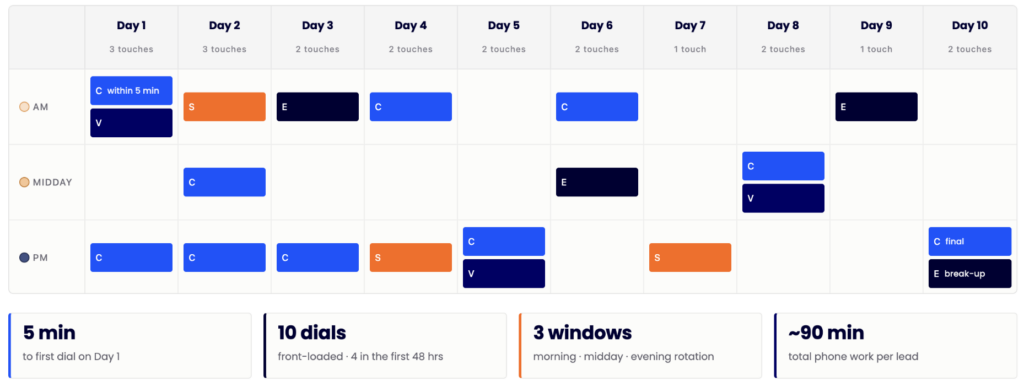
That benchmark assumes a properly executed 10-in-10 cadence. Ten contact attempts across ten business days for any lead that doesn’t pick up first time. Calls, voicemails, SMS, email, mixed across different times of day. Never “we called twice and gave up.”
If you’re not running 10-in-10 (or close to it), your contact rate will sit well short of 80%, regardless of how good your leads are.
The maths doesn’t work without persistence.
Around 40% of contactable homeowners answer on attempt five or later (with 60% of successful contacts occurring within the first 4). If you stop at attempt two, you’re throwing away nearly half your possible contacts before you’ve started.
Gap 1: The knowledge gap (“We don’t know what best practice lead management actually looks like”)
The cheapest of the three gaps to fix, because it’s just information.
Your company has a knowledge gap if nobody in the organisation is aware what best practice lead management looks like.
If you are in this position, and truly don’t know what effective lead management looks like, then the knowledge you seek is below.
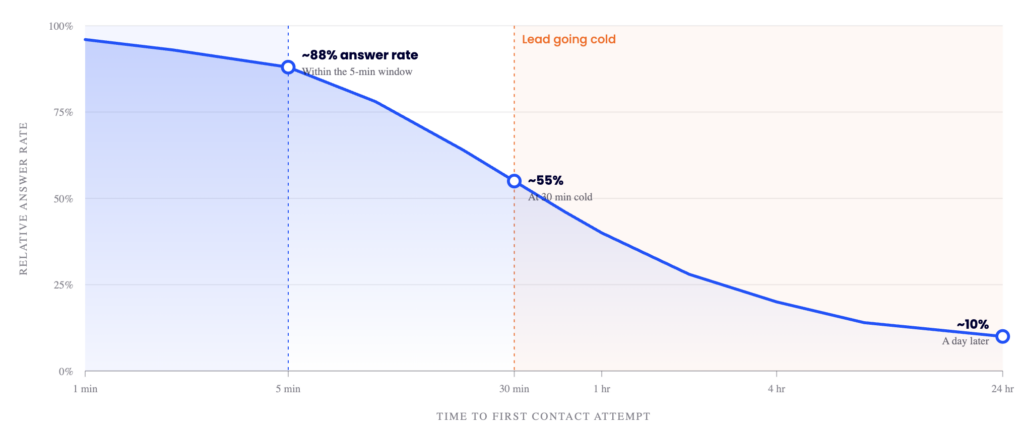
Speed to first contact
The five-minute rule.
A lead that goes 30 minutes without a contact attempt is materially less likely to answer than one called within five.
Elite operators dial within within five minutes during business hours. Speed isn’t a nice-to-have. It’s one of the biggest levers on first-contact rate.
The 10-in-10 cadence
Ten attempts across ten business days for any lead that doesn’t pick up the first time.
Vary the time of day. Morning, lunchtime, evening, weekend. Different people pick up at different times of day, and that’s why time-varied cadences outperform stacked calling. Vary the numbers you call from. Mobile numbers, local landlines, private numbers.
Multi-channel sequencing
Calling-only doesn’t get there.
We recommend all businesses test the use of a multi-channel cadence, which can catch different people at different moments.
For some clients we have found that calling-only cuts your contact rate compared to a properly mixed cadence.
Spam-flagged outbound numbers
This one frequently flies under the radar.
Sometimes, carriers flag your business number based on call patterns, recipient reports, and reputation scores. Once flagged, some calls don’t even ring through. Others get the kiss of death with a “Potential Spam” warning.
If your contact rate suddenly drops for no obvious reason, this is a common culprit. The best operators run a dialling pool of multiple rotating outbound numbers and check spam-flag status weekly through a caller-ID monitoring service.
Dialler quality and auto-dialers
VOIP setup issues, line drops, calls failing silently.
The elite-tier operators use predictive auto-dialers where the appointment setter doesn’t even choose the next lead. They use a rotating dialling pool of phone numbers. The system enforces the cadence and dials according to schedule. The human’s job is to talk to whoever picks up, not to decide who gets called next. The clients running this setup tend to sit at the top of the contact-rate league across our client base.
If any of that was new to you, that’s the knowledge gap. Close it by training the team and getting the right tools in place. The next two gaps ask more of you.
Gap 2: The measurement gap (“We don’t have the data to tell what’s actually happening”)
What gets measured gets managed.
What doesn’t get measured doesn’t happen.
If you don’t know how many dials each lead is receiving, or what your contact rate actually is, you have a data problem. We call it the measurement gap. Follow the recommendations below to close it.
CRM setup and time-to-first-contact logging
Speed to lead needs to be a number, not a feeling.
Every lead has a logged “time to first contact” timestamp. If you’re not in a CRM yet, a Google Sheet works fine. Treat it as a light CRM by proxy until you outgrow it. The point isn’t the tool. The point is that the first contact attempt is documented at the time it happens.
Logging every contact attempt
Every contact attempt after the first needs to be documented too.
A custom “dials” field in the CRM, incremented every time the lead is called i.e. each time a lead is called the Dials field is increased by 1. If your calling software integrates with your CRM, this can happen automatically. If you’re on mobile phones, it’s the appointment setter’s job to update the field after every attempt. Either way, it gets logged.
Without that, you can’t tell the difference between a lead that was worked properly and one that got two calls and a shrug.
The diagnostic question to ask your team
“We only contacted ten leads out of the first twenty.”
Well that’s not good enough.
So, what was the average number of contact attempts per lead in that cohort? If the answer is “I don’t know” or “I think I could find out,” you’re looking at the measurement gap in real time.
Document, report and manage your team using these numbers. You can’t manage what you can’t see, and you can’t see anything that isn’t tracked.
Reporting dashboards
Pro-Tip: Once you have this data, visualise it on a dashboard.
Even better if you’re in an office is to display it on a screen on the wall where the team walks past it every morning. Average time to first contact. Cadence completion rate by appointment setter. Average dials per lead. Contact rate by lead source and by rep. The act of putting these numbers in front of the team changes behaviour before you’ve done anything else.
Without measurement, the leadership gap below can’t even be diagnosed. The next conversation needs data to be useful.

Gap 3: The leadership gap (“The team know what to do, I just can’t get them to do it”)
If the team knows what to do (Gap 1 closed) and you can see what they’re actually doing (Gap 2 closed) and the contact rate is still too low, the gap is leadership.
This now becomes a sales management issue i.e. the way the team is run, resourced, motivated, and held to account.
Resourcing and bandwidth maths
Before you start managing the team harder, check the maths on resourcing. Do you have enough staff to effectively work the leads to the defined standard?
This can frequently trip up volume installers and businesses chasing scale. Lead purchase numbers step up. Staff numbers don’t. The team simply runs out of minutes in the day to work the leads at the cadence you’d want.
The Resource Calculator is built for exactly this. Put in your lead volume, the cadence you want to run, and the time you’re budgeting per lead. It tells you whether the team has the bandwidth or whether you’re effectively asking them to fail. Past a certain ratio, more leads stops meaning more sales. It means each lead gets less attention, contact rate drops, the leads that do pick up get a thinner qualifying call, and show-up rate drops downstream too.
If the maths comes back short, the fix isn’t to push the team harder. It’s to add staff, slow lead purchase, or restructure who does what. Once the resourcing maths is sound, the management levers below have something to bite on.
Lead ownership
Every lead is owned by one named person from the moment it lands. No shared queues where leads sit unclaimed for hours waiting for someone to grab them.
Ownership rules: no lead older than a defined window without a contact attempt, or it gets reassigned. In practice this means if a lead is not claimed and called within 10 minutes, it becomes someone elses.
Lead-orphaning is a leadership failure, not a process failure.
This works best on multi-person sales teams. If you don’t work that lead to the defined standard, it becomes someone else’s.
Commission scaled to cadence completion
This is a lever rarely pulled, and it’s one that can change behaviour the fastest.
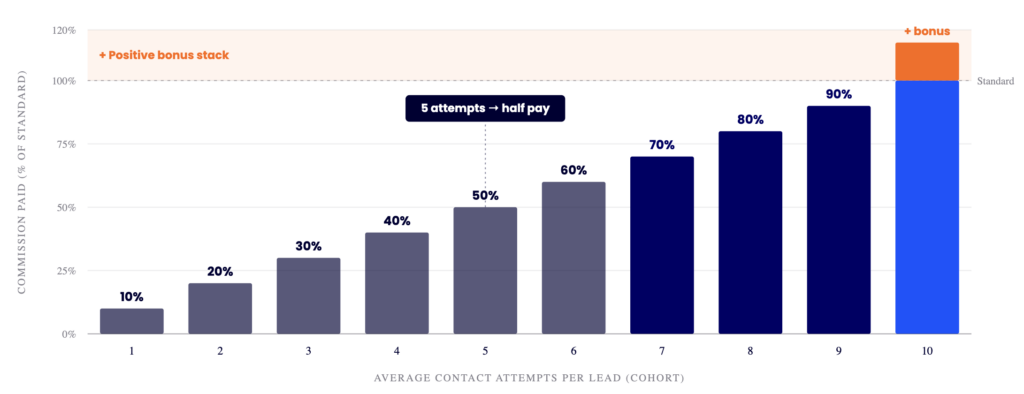
If the standard is ten contact attempts across ten days, and a rep’s average for the cohort is five attempts, they get 50% of commission on that cohort. Seven attempts, 70%. Ten attempts, full commission. Inputs gate the pay-out, not just outputs.
As you might expect, reps respond quickly.
Positive incentive stack
Don’t want to take away commissions? Fair enough, use the carrot instead of the stick.
Stack a positive incentive on top of the input-gating. If a rep cleanly hits 10-in-10 across a documented cohort, they get a bonus. Negative incentives keep the floor. Positive incentives raise the ceiling.
You can always test both.
Rep-level output KPIs
Hold reps to an output standard alongside the input one.
Above 80% contact rate as a rep-level KPI, not just a team-level one. Document, report on, and discuss these numbers in team meetings. The inputs are connected to the output, and they all need to be in the open.
This can be fun too, right? Hand out gold, silver and bronze medals to the team members with the fastest speed to lead. Call it the Usain Bolt award.
The elite operational standard
The best operators take it further.
Predictive auto-dialers where the call centre worker doesn’t even choose who to call. Dialling pools of rotated outbound numbers monitored weekly. Daily stand-ups on the dashboard. Weekly review of cohort-level cadence completion by rep. It looks excessive on the page until you see what it does to the contact rate.
The pattern worth sitting with: every lead-management problem that survives knowledge and measurement is a leadership problem.
The fix is training, incentives, accountability, ownership, and managing the team like the output actually matters to the business.
When it’s actually the leads
We have to be honest about this part, but only after you’ve worked through the three gaps above.
If your team is calling within five minutes, running a full 10-in-10 cadence across multiple channels, documenting every attempt, and sitting under a dashboard that says cadence completion is above 90%, and the contact rate is still well short, then the lead source is the variable to examine next.
A genuinely contactable lead has a real verified phone number, genuinely made an enquiry, hasn’t been sold to three other installers in the same week, and is fresh rather than recycled from a list six months old.
Shared leads racing three to five installers contact at materially lower rates because the customer is fielding calls from everyone at once. Disconnected numbers and aged data drag the rate down further. Phantom leads that never had a real form completion drag it down further still.
That’s a diagnostic step, not a pitch. If you’ve ruled out the three internal gaps, the next conversation is about where your leads are coming from and what they actually are.
What “fixed” looks like
This is the promised land.
The team is sized to the lead volume, with enough phone time budgeted to run the cadence properly. Every lead is contacted within five minutes (at least during business hours). The team runs a 10-in-10 cadence on every lead that doesn’t pick up first time, mixed across calls, voicemails, SMS, and email.
Measurement is locked down. Every contact attempt is logged, ideally automatically through a dialler-CRM integration. The dashboard on the wall (real or virtual) shows contact rates above 80% and cadence completion above 90%, broken down by rep. Commission scales with inputs as well as outputs.
This will mean that contact rate is an issue of the past. Now it will become converting those successful connects to a qualified appointment. Fortunately, we will cover that in an upcoming post.
Where this fits in the bigger picture
A contact rate above 80% is one of five funnel metrics every solar installer should be tracking.
We’ve covered the full framework in our 4-stage readiness checklist. The other four metrics get harder to read if contact rate is broken, because so few leads reach the next stage of the funnel.
For sizing up the time it takes to run a proper 10-in-10 cadence across your lead volume, use the Resource Calculator.
It’s the fastest way to work out whether your team has the bandwidth to do this well, or whether your team structure itself is the bottleneck.
Want a second pair of eyes on your numbers?
If your contact rate is sitting below where you want it and you’d like a second pair of eyes on what’s actually happening between leads landing and calls being made, request lead pricing and we’ll have a real conversation.