

A common request we get from clients: “How can we get more volume?”
Makes sense… you’re working leads, converting sales and more leads means more appointments, more quotes, more jobs, and every growing business should be asking for it.
So we ask one question back: “What are our constraints? We assume you’d like more volume, at the same quality and the same cost?”
Almost every time the honest answer is “Yes, more leads, but don’t change quality or cost”.
In some instances, our lead generation campaigns are able to drive more volume, and that’s an easy yes!
However, in some other cases we’re faced with the dreaded Lead Generation Trilemma… and if you’re reading this now, you’re likely facing that with us.
The Lead Gen Trilemma: Pick Two Out Of 3
A trilemma is a three-way choice where you can’t have all of it.
An example of a trilemma most have heard of is “good, fast or cheap”:
- Want good & fast – it won’t be cheap!
- Want fast & cheap – it won’t be good!
- Want good & cheap – it won’t be fast!
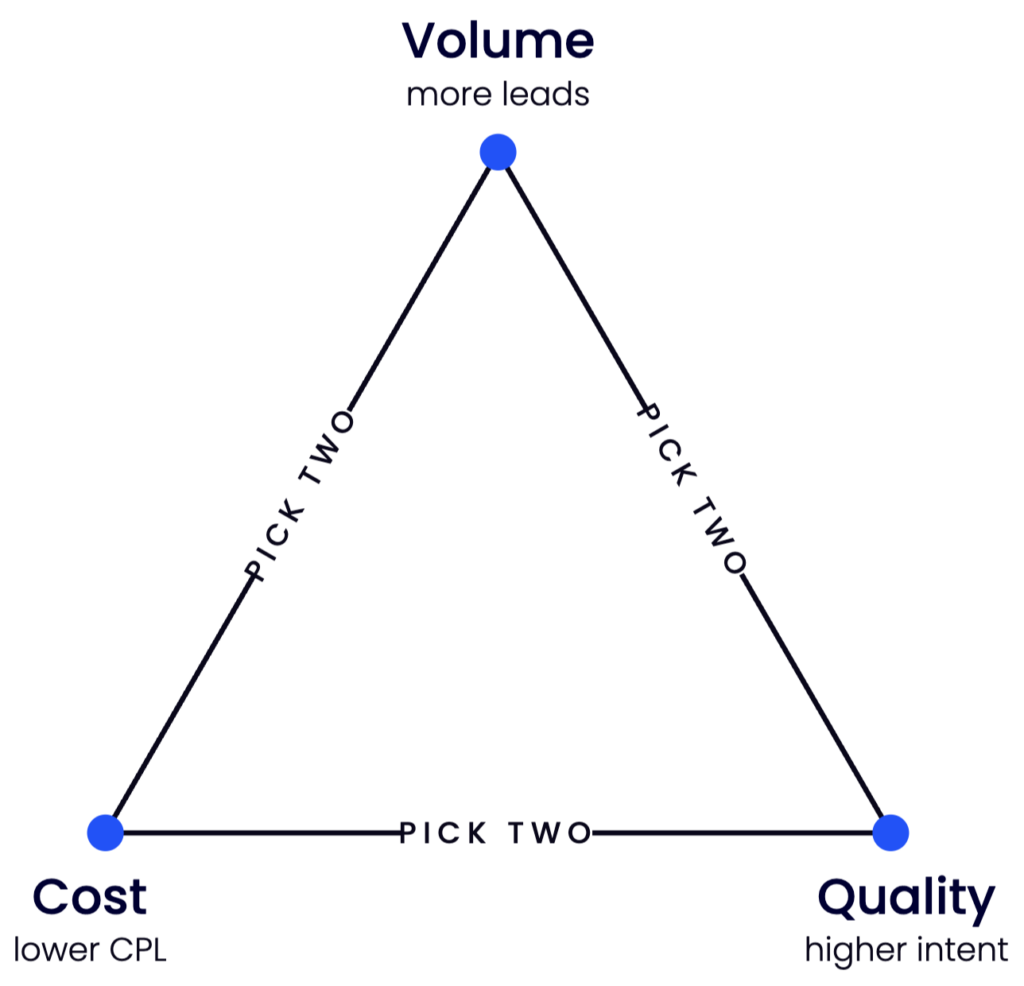
In lead generation, when we have campaigns at full capacity those 3 choices are:
- Lead Cost
- Lead Quality
- Lead Volume
The iron law is that you can optimise for two, only by giving up the third.
Every lever that pulls two corners toward you drags the third one away. There’s no combination of targeting, spend, channels and qualification that maximises all three at the same time.
Anyone who tells you otherwise is selling you the impossible corner.
Three honest positions
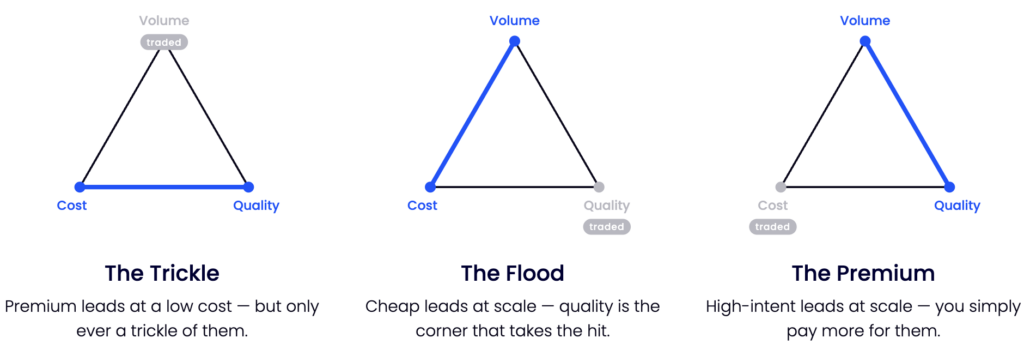
Because you pick two, there are only three stable positions to occupy. Every one of them gives something up.
The Trickle is low cost leads and good quality, so you get low volume. Tight targeting, heavy qualification, only your best-performing channels, spend held on a throttle. You get great leads at a good price. You just won’t get many of them.
The Flood is low cost leads and high volume, so quality drops. Low-friction offers, cheaper or unproven advertising channels, minimal verification, shorter forms. You get plenty of low-cost leads. However, quality and intent collapse, and your sales team spends its day on people who were never going to buy.
The Premium is high quality and high volume, so you pay a high cost. LeadsHQ occupies this space with our exclusive, SMS-verified leads. Advertising only using proven channels, highly targeted audiences, and heavy qualification held all the way at scale. You get lots of great leads. However, you pay a premium CPL to get them.
Transparently, none of these are specifically right or wrong, they’re just different.
The best fit is whichever suits your business, your sales bandwidth and your margins right now. (If you’re not sure your business is set up to convert leads at all yet, start with the readiness checklist before you worry about which corner to trade.)
“Can we get more volume?”… A Deep Dive
Back to the common client ask, because it deserves more attention.
The request almost always arrives with quality locked. Nobody wants more leads if they’re lower quality. That’s just the Flood, and you’d feel it in your conversion rate inside a fortnight.
So we hold quality constant, exactly as you’d want us to.
The problem is that holding quality constant switches off every lever that normally makes increasing or scaling lead volume cheap. We can’t loosen targeting, broaden or “spice up” the offers, drop verification or shorten the qualification forms.
Each of these would buy volume by spending quality, and we know the importance of protecting quality.
With quality nailed down, there are only two ways left to manufacture more volume, and both of them push cost up.
1. Scale spend on the proven performers
Take a campaign, ad set or audience that’s working and push budgets, and your cost per lead rises. Every time.
Here’s why. At lower advertising spends you’re buying the cheapest, best-fit inventory first, the impressions that were always going to be cheapest to convert.
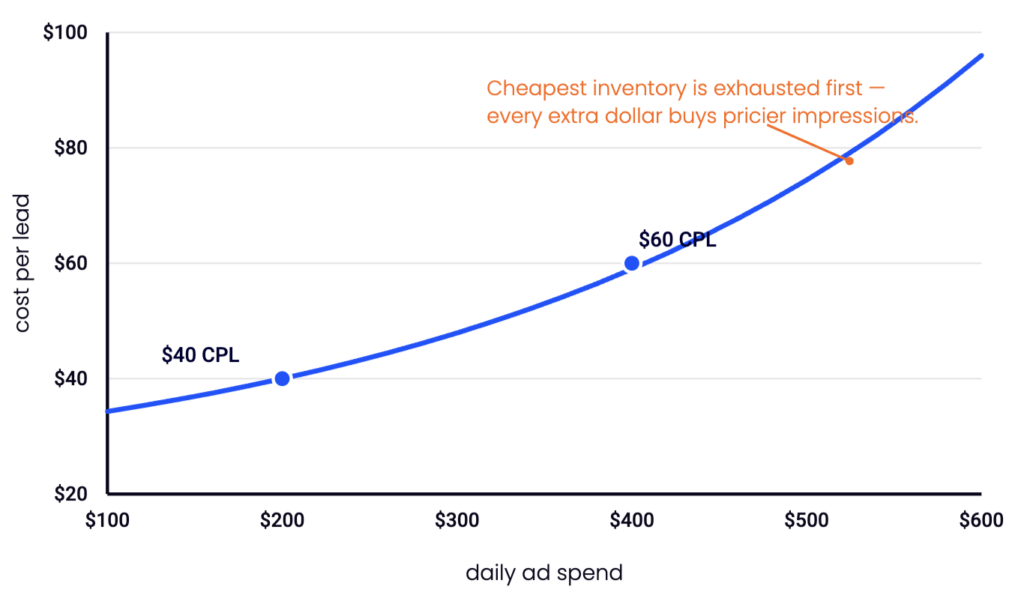
As you scale, every extra dollar buys progressively more expensive impressions: worse placements, colder audiences, more auction competition for the same eyeballs.
Scaling is diminishing returns. That’s just how ad auctions on the Google and Meta platforms work. Volume goes up, and CPL goes up with it. There’s no version of “spend more” that also means “pay less per lead.”
2. Test more elements, faster (creative, landing pages, etc)
Scaled budgets burn through creative.
Run the same ads at double the spend and they fatigue: the audience has seen them, and response drops. To keep feeding a bigger budget, you have to launch and kill new creative faster.
We call that a higher creative testing velocity.
Testing isn’t free, and here’s the part that’s easy to miss. More tests means more losers, not just more winners.
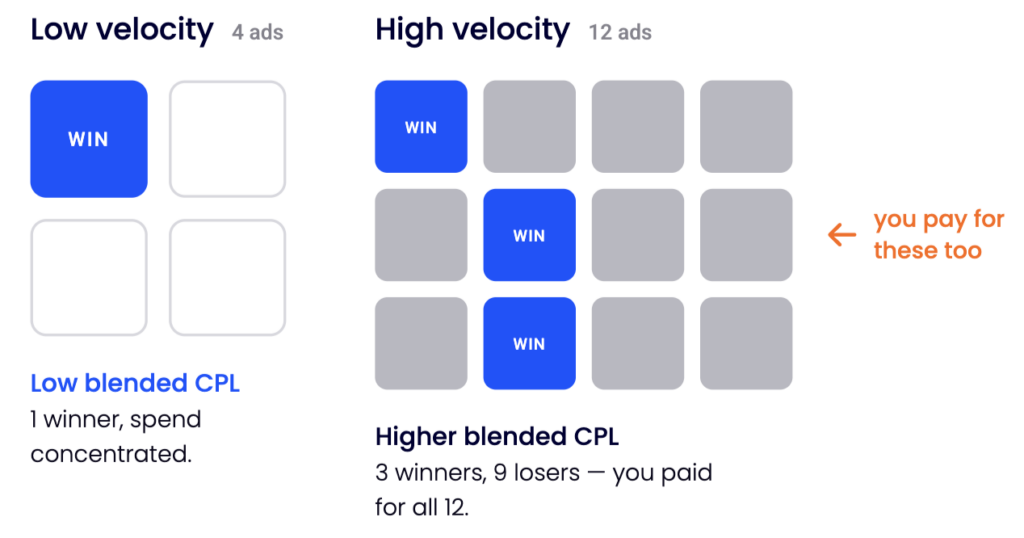
When we consolidate spend behind a handful of proven winners, we’re running our most efficient inventory, so the blended CPL stays low because nearly every dollar goes to something that works.
The moment we ramp testing to feed a bigger budget, a real share of spend flows to concepts that underperform before we spot them and switch them off. You get more winners. You also pay for every loser it took to find them, and that lifts your blended CPL.
The Honest Equation
Put the two together and you get one line that isn’t up for negotiation.
Volume up, quality held constant, cost has to rise. There’s no way around it.
For campaigns that are already at their limits, the only way to add volume without raising cost is to let quality slide, and that’s never an option.
So when the request is more volume at the same quality and the same cost, the honest answer is to tell you which corner has to give and let you choose.
The other two asks are the same trade-off, mirrored
Volume gets the deep dive because it’s the most common. The other two requests obey the same law.
“Reduce my cost per lead.” The levers are cut spend, broaden into cheaper channels, loosen qualification, shorten forms, drop SMS or verification. Hold volume constant and quality has to fall. Hold quality constant and volume has to fall. Try to hold both, and cost won’t come down.
“Improve my lead quality.” The levers are more qualification questions, higher-intent messaging, filtering and disqualification logic, consolidating behind your best channels, cutting the low performers, adding verification.
By definition, fewer leads clear a higher bar, so volume falls. And the highest-quality channels tend to be the most expensive, so cost rises. Usually you feel both at once.
Same triangle, every time. (This is also why cost per lead is the wrong number to optimise in isolation: a cheaper lead that converts worse isn’t cheaper at all once it reaches your P&L.)
We can’t break the triangle, but over time we can make it bigger
Something to keep in mind is that the triangle isn’t fixed forever.
Over a long-term timeframe, better data, sharper creative, tighter systems and smarter routing push the whole frontier outward. Next year’s “high quality” lead has the potential to sit at a better cost and higher volume than this year’s did.
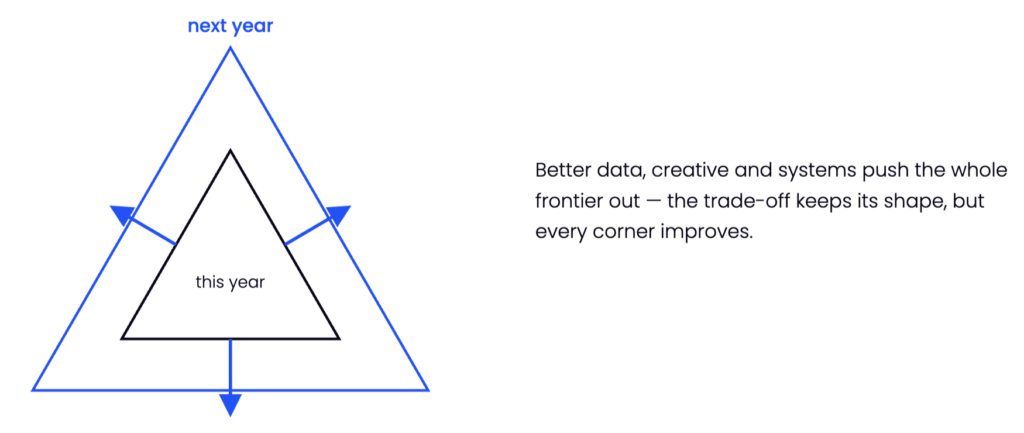
That’s because as a company our goal is to increase capacity over time. Unfortunately, it doesn’t exempt anyone from the law today. At any single moment, we’re still trading along an edge.
So if you want more lead volume at the same quality today, I’m afraid we need to have a chat about lead price.
Frequently asked questions
Why can’t I get more leads at the same quality and the same price?
Sometimes you can.
If a campaign isn’t yet at capacity, we can often lift volume without touching quality or cost, and that’s an easy yes. The trilemma only bites once a campaign is running at its limits. From there, holding quality constant switches off every lever that makes extra volume cheap: you can’t loosen targeting, broaden the offer or shorten the qualification form without spending quality.
That leaves two ways to add volume, and both push cost up. You scale spend, which buys progressively more expensive inventory once the cheapest is exhausted, and you test more elements (creative, landing pages and so on) faster, which means paying for more losers alongside the winners. So for a campaign already at capacity, more volume at the same quality costs more.
What is the lead generation trilemma?
It’s the lead generation version of “good, fast or cheap, pick two.” The three corners are cost, quality and volume, and you can optimise for any two only by giving up the third. Lower cost and higher quality means lower volume. Lower cost and higher volume means lower quality. Higher quality and higher volume means higher cost. No setting maximises all three at once, and it bites hardest once a campaign is already running at full capacity.
Why does cost per lead go up when I increase ad spend?
Ad platforms like Google and Meta serve the cheapest, best-fit impressions first. At lower spend you’re buying that cheap inventory. As you scale, every extra dollar buys progressively more expensive impressions: worse placements, colder audiences, more auction competition. So a bigger budget lifts total volume but raises the cost of each extra lead. Scaling is diminishing returns by nature.
Can the lead generation trade-off ever be improved?
Yes, but slowly. Over the long term, better data, sharper creative, tighter systems and smarter routing push the whole frontier outward, so next year’s high-quality lead can sit at a better cost and higher volume than this year’s. That’s us increasing capacity over time, and it doesn’t remove the trade-off today. At any single moment we’re still trading along the edge, so a campaign already at capacity still needs a conversation about lead price.